Tag Archive: religion


Jesus is the Lamb of God

Jesus is the Lamb of God who shed His blood and gave His life that we shall live forever in the presence of God.

lambofgod

The fact that Jesus was called the Lamb of God is a prophetic statement in itself. It draws on the analogies of the blood sacrifice of the Altar of Burnt Offerings. Here is a statement made by John, the Baptist:

The next day John saw Jesus coming toward him, and said, “Behold! The Lamb of God who takes away the sin of the world!” (John 1:29)


Jesus is the Altar of Burnt Offerings

 Foundational material necessary to understanding this post can be viewed in the two postings below:

 The-Altar-of-Burnt-Offerings

The-Activities-at-the-Altar-of-Burnt-Offerings
 

The Tabernacle

 The purpose of introducing this material is to lay the groundwork toward understanding that the shedding of blood and the sacrifice of life at the Altar of Burnt Offerings are prophetic of Jesus who is the Christ. This statement becomes extremely clear when we look for its fulfillment in the life of Jesus. Jesus shed His blood[ii] and sacrificed His body, laying down His life[iii] so that we would be forgiven[iv] of our sins.

jesus-on-the-cross1

 In addition, Jesus is the perfect sacrifice for this purpose because He is the perfect Son of God who lived His life without sin[v]. He was held down by the hands of the high priests[vi] who were effectively the head of the nation. When they sent Jesus to His death they said, “Let His blood be upon us and upon our children[vii].” Therefore, the blood of this perfect sacrifice resulted in the forgiveness of sin[viii] for the nation that would believe in Him. The consequence of these facts is that His sacrifice brings a far better benefit than was achieved at the Alter.


Here is a scripture that explains this fact rather well:

‘Therefore not even the first covenant was dedicated without blood. For when Moses had spoken every precept to all the people according to the law, he took the blood of calves and goats, with water, scarlet wool, and hyssop, and sprinkled both the book itself and all the people, saying, “This is the blood of the covenant which God has commanded you.” Then likewise he sprinkled with blood both the tabernacle and all the vessels of the ministry. And according to the law almost all things are purified with blood, and without shedding of blood there is no remission. Therefore it was necessary that the copies of the things in the heavens should be purified with these, but the heavenly things themselves with better sacrifices than these. For Christ has not entered the holy places made with hands, which are copies of the true, but into heaven itself, now to appear in the presence of God for us; not that He should offer Himself often, as the high priest enters the Most Holy Place every year with blood of another. He then would have had to suffer often since the foundation of the world; but now, once at the end of the ages, He has appeared to put away sin by the sacrifice of Himself. And as it is appointed for men to die once, but after this the judgment, so Christ was offered once to bear the sins of many. To those who eagerly wait for Him He will appear a second time, apart from sin, for salvation.’

 ‘For the law, having a shadow of the good things to come, and not the very image of the things, can never with these same sacrifices, which they offer continually year by year, make those who approach perfect. For then would they not have ceased to be offered? For the worshipers, once purified, would have had no more consciousness of sins. But in those sacrifices there is a reminder of sins every year. For it is not possible that the blood of bulls and goats could take away sins. Therefore, when He came into the world, He said: “Sacrifice and offering You did not desire, But a body You have prepared for Me. In burnt offerings and sacrifices for sin You had no pleasure. Then I said, ‘Behold, I have come; In the volume of the book it is written of Me; To do Your will, O God.” Previously saying, “Sacrifice and offering, burnt offerings, and offerings for sin You did not desire, nor had pleasure in them” (which are offered according to the law), then He said, “Behold, I have come to do Your will, O God.” He takes away the first that He may establish the second. By that will we have been sanctified through the offering of the body of Jesus Christ once for all. And every priest stands ministering daily and offering repeatedly the same sacrifices, which can never take away sins. But this Man, after He had offered one sacrifice for sins forever, sat down at the right hand of God, from that time waiting till His enemies are made His footstool. For by one offering He has perfected forever those who are being sanctified. But the Holy Spirit also witnesses to us; for after He had said before, “This is the covenant that I will make with them after those days,” says the LORD: “I will put My laws into their hearts, and in their minds I will write them,” then He adds, “Their sins and their lawless deeds I will remember no more.” Now where there is remission of these, there is no longer an offering for sin.’ (Hebrews 9:18 – 10:18) 

Therefore, the single sacrifice of the body and blood of Jesus is the perfect fulfillment of all the sacrifices at the Altar of Burnt Offerings. What this means is that the prophecy of the Brazen Altar is fulfilled in the sacrifice of Christ Jesus on the cross. Jesus therefore is the Lamb of God whose innocent blood was shed to carry away the sins of the world[ix].


Since His sacrifice was perfect He made obsolete the Altar of Burnt Offerings as well as the blood sacrifice of animals. The consequence of this is that the priests who performed these functions are also no longer required. Therefore, the law pertaining to the priestly duties at the Altar of Burnt Offerings was no longer necessary. A common saying today is that Jesus is the fulfillment of the law, and by understanding His sacrifice on the cross, we realize how this obsolescence occurred.

 As we have covered earlier, Jesus proclaimed Himself to be “The Way”, and therefore the passageway into the courtyard of the Tabernacle. We can validate this claim by investigating the attributes and functions of the Tabernacle court and then authenticating that they are achievable through Jesus, and can be validated by looking at His actions and words.

Based on the correlation between what we have presented about the Alter of Burnt offerings, and Jesus’ sacrifice on the cross, we conclude that Jesus is the fulfillment of the Alter of Burnt Offerings’. In fact, we conclude that Jesus is also the sacrifice, the offering and the high priest all rolled into one. He is the sacrificial Lamb who was slain, and whose body and blood are given in exchange for the forgiveness of our sins. His body and blood are the new covenant[x] that eliminates the need for the Altar of Burnt Offerings and the Leviticus priesthood. He is the perfect sacrifice required for the reestablishment of our love relationship with God.

Therefore, His statement “I am the Way …” indicates that forgiveness of sin comes only through Him.

[i] Leviticus 4:22 – 26 When a ruler has sinned, and
done something unintentionally against any of the commandments of the LORD his God in anything which should not be done, and is guilty, or if his sin which he has committed comes to his knowledge, he shall bring as his offering a kid of the goats, a male without blemish. And he shall lay his hand on the head of the goat, and kill it at the place where they kill the burnt offering before the LORD. It is a sin offering. The priest shall take some of the blood of the sin offering with his finger, put it on the horns of the altar of burnt offering, and pour its blood at the base of the altar of burnt offering. And he shall
burn all its fat on the altar, like the fat of the sacrifice of the peace
offering. So the priest shall make atonement for him concerning his sin, and it shall be forgiven him.

[ii] John 19:34 But one of the soldiers pierced His side with a spear, and immediately blood and water came out.

[iii] John 19:30 So when Jesus had received the sour wine, He said, “It is finished!” And bowing His head, He gave up His spirit.

[iv] Matthew26:28 For this is My blood of the new covenant, which is shed for many for the remission of sins.

[v] Hebrews 4:15 For we do not have a High Priest who cannot sympathize with our weaknesses, but was in all points tempted as we are, yet without sin.

[vi] Matthew 27:20 But the chief priests and elders persuaded the multitudes that they should ask for Barabbas and destroy Jesus. The governor answered and said to them, “Which of the two do you want me to release to you?” They said, “Barabbas!” Pilate said to them,
“What then shall I do with Jesus who is called Christ?” They all said
to him, “Let Him be crucified!” Then the governor said, “Why, what evil has He done?” But they cried out all the more, saying, “Let Him be crucified!” When Pilate saw that he could not prevail at all, but rather that a tumult was rising, he took water and washed his hands before the multitude, saying, “I am innocent of the blood of this just Person. You see to it.”

[vii] Matthew 27:25 And all the people answered and said, “His blood be on us and on our children.”

[viii] Acts 26:15 – 18 So I said, ‘Who are You, Lord?’ And He said, ‘I am Jesus, whom you are persecuting. ‘But rise and stand on your feet; for I have appeared to you for this purpose, to make you a minister and a witness both of the things which you have seen and of the things which I will yet reveal to you. ‘I will deliver you from the Jewish people, as well as from the Gentiles, to whom I now send you, to open their eyes, in order to turn them from darkness to light, and from the power of Satan to God, that they may receive forgiveness of sins and an inheritance among those who are sanctified by faith in Me.’

[ix] John 1:29 The next day John saw Jesus coming toward him, and said, “Behold! The Lamb of God who takes away the sin of the
world!

[x] Luke 22:19 – 20 And He took bread, gave thanks and broke it, and gave it to them, saying, “This is My body which is given for you; do this in remembrance of Me. Likewise He also took the cup after supper, saying, “This cup is the new covenant in My blood, which is shed for you.


Read my amazing true life story about how the forces of good and evil battle for my life and the vision that God has given me. My book, “Possess the Vision,” communicates my supernatural experiences and as a result, provides insight into the realm of the spiritual warfare that is raging for our souls and our purpose. This is a must read for all Christians. Learn more by following this link: Possess-the-Vision-at-Amazon

The Morning Star Rising on the First Day

The Activities at the Altar of Burnt Offerings

The activities performed at the Altar give valuable insight into what was actually being accomplished there.

tabernacle-courtyard

The following passage taken from the Book of Leviticus describes one of the many processes that God gave Moses to perform at the Altar of Burnt Offerings:

It came to pass on the eighth day that Moses called Aaron and his sons and the elders of Israel. And he said to Aaron, “Take for yourself a young bull as a sin offering and a ram as a burnt offering, without blemish, and offer them before the LORD. And to the children of Israel you shall speak, saying, Take a kid of the goats as a sin offering, and a calf and a lamb, both of the first year, without blemish, as a burnt offering, also a bull and a ram as peace offerings, to sacrifice before the LORD, and a grain offering mixed with oil; for today the LORD will appear to you.” So they brought what Moses commanded before the tabernacle of meeting. And all the congregation drew near and stood before the LORD. Then Moses said, “This is the thing which the LORD commanded you to do, and the glory of the LORD will appear to you.” And Moses said to Aaron, “Go to the altar, offer your sin offering and your burnt offering, and make atonement for yourself and for the people. Offer the offering of the people, and make atonement for them, as the LORD commanded.” Aaron therefore went to the altar and killed the calf of the sin offering, which was for himself. Then the sons of Aaron brought the blood to him. And he dipped his finger in the blood, put it on the horns of the altar, and poured the blood at the base of the altar. But the fat, the kidneys, and the fatty lobe from the liver of the sin offering he burned on the altar, as the LORD had commanded Moses. The flesh and the hide he burned with fire outside the camp. And he killed the burnt offering; and Aaron’s sons presented to him the blood, which he sprinkled all around on the altar. Then they presented the burnt offering to him, with its pieces and head, and he burned them on the altar. And he washed the entrails and the legs, and burned them with the burnt offering on the altar. Then he brought the people’s offering, and took the goat, which was the sin offering for the people, and killed it and offered it for sin, like the first one. And he brought the burnt offering and offered it according to the prescribed manner. Then he brought the grain offering, took a handful of it, and burned it on the altar, besides the burnt sacrifice of the morning. He also killed the bull and the ram as sacrifices of peace offerings, which were for the people. And Aaron’s sons presented to him the blood, which he sprinkled all around on the altar, and the fat from the bull and the ram; the fatty tail, what covers the entrails and the kidneys, and the fatty lobe attached to the liver; and they put the fat on the breasts. Then he burned the fat on the altar; but the breasts and the right thigh Aaron waved as a wave offering before the LORD, as Moses had commanded. Then Aaron lifted his hand toward the people, blessed them, and came down from offering the sin offering, the burnt offering, and peace offerings. And Moses and Aaron went into the tabernacle of meeting, and came out and blessed the people. Then the glory of the LORD appeared to all the people, and fire came out from before the LORD and consumed the burnt offering and the fat on the altar. When all the people saw it, they shouted and fell on their faces. (Leviticus 9:1-24)

The Tabernacle Courtyard

The Tabernacle Courtyard

The Altar therefore, was the place that the priesthood offered blood and animal sacrifices on behalf of the people. These sacrifices included covering the priest, the Altar, the people and the objects inside the Tabernacle in the blood of the sacrifice, for the covering of sin[i]. Tradition has it that the process often involved the head of the family (who represented the entire family), to bring a perfect sacrifice (a lamb without spot, stain or blemish) to the Tabernacle court. The family head would hold the animal down with his hands, therein transferred the sins of the family to the animal. The priest would then cut the animals throat so that the sins of the family flowed out with its blood.

If he brings a lamb as his sin offering, he shall bring a female without blemish. Then he shall lay his hand on the head of the sin offering, and kill it as a sin offering at the place where they kill the burnt offering. The priest shall take some of the blood of the sin offering with his finger, put it on the horns of the altar of burnt offering, and pour all the remaining blood at the base of the altar. He shall remove all its fat, as the fat of the lamb is removed from the sacrifice of the peace offering. Then the priest shall burn it on the altar, according to the offerings made by fire to the LORD. So the priest shall make atonement for his sin that he has committed, and it shall be forgiven him. (Leviticus 4:32-35)

We will present how Jesus fulfills the prophesy of the Altar of Burnt Offerings and all of the activities performed around it in our next posting.


The Altar of Burnt Offerings

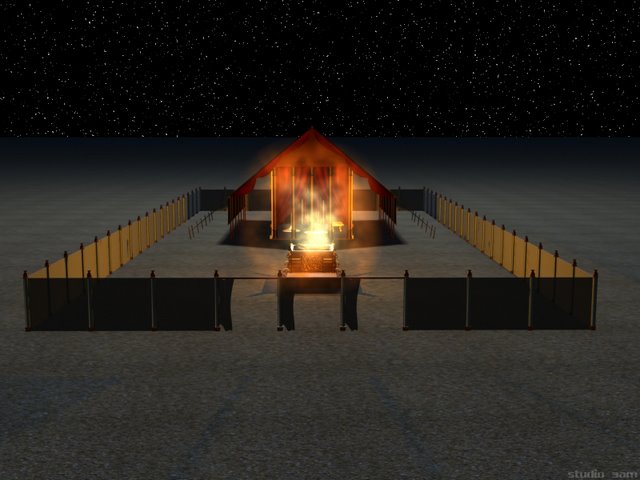
The Altar of Burnt Offerings can clearly be seen in the following picture. It is the object producing the flames in the center of the Tabernacle Courtyard.

the-full-tabernacle6

At the time of the Levitical Priesthood, God required blood sacrifices at the Alter of Burnt Offerings for the forgiveness of sins. These sacrifices required the priest to slaughter a goat, sheep or cow and have the choice body parts burned on the Altar. Then the priest would sprinkle the blood of the animal on the Altar, the people and himself.

Like all of the objects in the Tabernacle, God provided the specifications for building the Altar of Burnt Offerings. This is evidenced by the following scripture:

You shall make an altar of acacia wood, five cubits long and five cubits wide; the altar shall be square; and its height shall be three cubits. You shall make its horns on its four corners; its horns shall be of one piece with it. And you shall overlay it with bronze. Also you shall make its pans to receive its ashes, and its shovels and its basins and its forks and its firepans; you shall make all its utensils of bronze. You shall make a grate for it, a network of bronze; and on the network you shall make four bronze rings at its four corners. You shall put it under the rim of the altar beneath, that the network may be midway up the altar. And you shall make poles for the altar, poles of acacia wood, and overlay them with bronze. The poles shall be put in the rings, and the poles shall be on the two sides of the altar to bear it. You shall make it hollow with boards; as it was shown you on the mountain, so shall they make it. (Exodus 27:1-8)

The Brazen Altar (or Alter of Burnt Offerings) is made of acacia wood and is covered with bronze. It is about ten and one half feet long, ten and one half feet deep and six feet three inches tall. There are horns of equal size placed on each of the corners of the Altar. It should be noted that there are a number of tools available to assist the priest in his work.


The Morning Star Rising on the First Day

Read my story by ordering my book, “Possess the Vision”

The Tabernacle Fence and Gate


The Tabernacle fence and gate can be seen in the following pictures:


the-full-tabernacle5


tabernacle-gate

The following passage from the book of Exodus defines the fence that encircles the Courtyard:


You shall also make the court of the tabernacle. For the south side there shall be hangings for the court made of fine woven linen, one hundred cubits long for one side. And its twenty pillars and their twenty sockets shall be bronze. The hooks of the pillars and their bands shall be silver. Likewise along the length of the north side there shall be hangings one hundred cubits long, with its twenty pillars and their twenty sockets of bronze, and the hooks of the pillars and their bands of silver. And along the width of the court on the west side shall be hangings of fifty cubits, with their ten pillars and their ten sockets. The width of the court on the east side shall be fifty cubits. The hangings on one side of the gate shall be fifteen cubits, with their three pillars and their three sockets. And on the other side shall be hangings of fifteen cubits, with their three pillars and their three sockets. For the gate of the court there shall be a screen twenty cubits long, woven of blue, purple, and scarlet thread, and fine woven linen, made by a weaver. It shall have four pillars and four sockets. All the pillars around the court shall have bands of silver; their hooks shall be of silver and their sockets of bronze. The length of the court shall be one hundred cubits, the width fifty throughout, and the height five cubits, made of fine woven linen, and its sockets of bronze. All the utensils of the tabernacle for all its service, all its pegs, and all the pegs of the court, shall be of bronze. (Exodus 27:9-19)


More information Can be found about the Tabernacle Gate by clicking on the following link: The-Tabernacle-Gate


Read my amazing true life story about how the forces of good and evil battle for my life and the vision that God has given me. My book, “Possess the Vision,” communicates my supernatural experiences and as a result, provides insight into the realm of the spiritual warfare that is raging for our souls and our purpose. This is a must read for all Christians. Learn more by following this link: Possess-the-Vision-at-Amazon


The Morning Star Rising on the First Day

Read my story by ordering my book, “Possess the Vision”

The Tabernacle and Jesus


The Tabernacle was built to be the earthly abode of God and the place where God would dwell among His people.

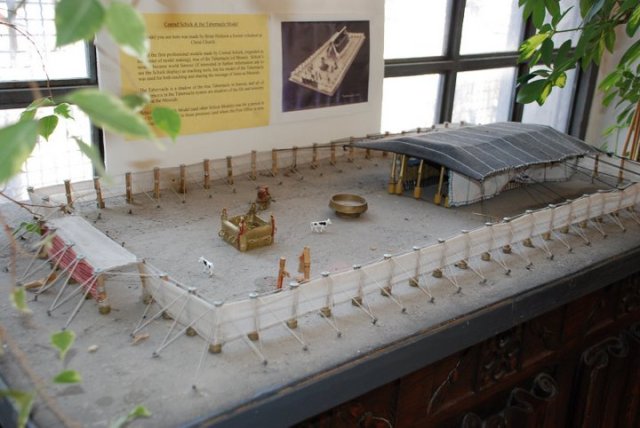
The following picture depicts what the Tabernacle of Moses may have looked like:

the-tabernacle

Moses built the Tabernacle in conformance to the exact specifications provided by God. For example, God gives Moses a detailed list of items required to build the Tabernacle in the following scripture:


Then the LORD spoke to Moses, saying: “Speak to the children of Israel, that they bring Me an offering. From everyone who gives it willingly with his heart you shall take My offering. And this is the offering which you shall take from them: gold, silver, and bronze; blue, purple, and scarlet thread, fine linen, and goats’ hair; ram skins dyed red, badger skins, and acacia wood; oil for the light, and spices for the anointing oil and for the sweet incense; onyx stones, and stones to be set in the ephod and in the breastplate. And let them make Me a sanctuary, that I may dwell among them. According to all that I show you, that is, the pattern of the tabernacle and the pattern of all its furnishings, just so you shall make it.” (Exodus 25:1-9)


This passage also emphasizes the building of God’s Tabernacle precisely to His instructions. This is just one of several statements found in scripture regarding God’s desire to have the Tabernacle built precisely to His instruction. This fact suggests that the Tabernacle’s form and content are extremely important; that it is built on a heavenly model designed to enable God to dwell among His people. This is because He seeks to restore the relationship with man that was lost in the garden.

We must now consider that if all of this is true then should not the Son of God also possess all of the attributes and functionality of the Tabernacle? What we will demonstrate is that the Tabernacle is prophetic of Christ. Would the purpose of God have changed from the time of Moses until the time of Christ? I think not. God continues to strive to restore the relationship lost with man at the fall. Therefore, we believe that the Tabernacle is prophetic of Christ. We believe that when we look at the functions and purpose of the Tabernacle and each of its components, that we will find them predictive of the function and purpose in the life of Christ Jesus. It is for this reason that we will use the Tabernacle and it components to demonstrate that Jesus is the Christ.

For example, we believe that the Tabernacle should give us some insight into the types of relationships that man can have with God. We further believe that if the pattern of the Tabernacle provides this insight then we should expect to see these types of relationships manifest through Christ as well.

What we are about to find out is that the Tabernacle not only helps us understand the types of relationships possible with God but that these relationships were manifest through the life of Jesus.

When we look into the physical structure of the Tabernacle we will find that it is composed of three major sections. The sections can only be entered in an order that represents a deeper or closer relationship with God.

The first section is the Tabernacle Court and it presents man with a relationship of God’s grace. When Jesus claims to be the Way, He is claiming to be the passageway to the Tabernacle Court.


tabernacle-courtyard


The second section of the Tabernacle is called the Holy Place and it is presents man with a relationship of God’s empowerment. When Jesus claims to be the Truth, He is claiming to be the passageway to the Holy Place of the Tabernacle.


holy-place


The third section of the Tabernacle is called the Most Holy place and it presents man with a relationship of covenant. When Jesus claims to be the Life He is claiming to be the passageway to the Most Holy Place.


priest-and-holy-of-holies


Read my story by ordering my book, “Possess the Vision”


Jesus is the Way, the Truth, and the Life

Jesus made a number of statements about His identity in scripture. However, the following statement is the foundation of our analysis as in Jesus correlates Himself to the Tabernacle. The statement is presented here:

Thomas said to Him, “Lord, we do not know where You are going, and how can we know the way?” Jesus said to him, “I am the way, the truth, and the life. No one comes to the Father except through Me.” (John 14:5-6)

This statement is compelling on its face value alone as we know that Jesus is talking about being the passageway to the Father. However, the terms, “The Way, The Truth and The Life” are symbolic of the passageways (or veils) into each compartment of the Tabernacle. In turn each passageway leads to a progressively deeper relationship with the Father. We will learn a great deal more about these passageways in subsequent postings.

Let us first start by presenting a scripture that confirms that Jesus viewed His body as a temple (which the Tabernacle is)[i]:

So the Jews answered and said to Him, “What sign do You show to us, since You do these things?” Jesus answered and said to them, “Destroy this temple, and in three days I will raise it up.” Then the Jews said, “It has taken forty-six years to build this temple, and will You raise it up in three days?” But He was speaking of the temple of His body. (John 2:18-21)

In speaking these words, Jesus is claiming to be the living Tabernacle and the divine fulfillment of all prophesies regarding it. To validate this assumption, we will now embark on a detailed investigation of the Tabernacle in the anticipation that it will guide us to Christ. We will examine the function and purpose of each Tabernacle object and will look at many of the process performed by the priests there as well.


[i] Revelation 15:5 After these things I looked, and behold, the temple of the tabernacle of the testimony in heaven was opened.

Striving To Become Like Jesus


Striving To Become Like Jesus

One of the key assumptions of this post is that God wants us to become like Him and the following scriptures support this position very well  :

He who says he abides in Him ought himself also to walk just as He walked. (1 John 2:6)

Beloved, now we are children of God; and it has not yet been revealed what we shall be, but we know that when He is revealed, we shall be  like Him, for we shall see Him as He is. (1 John 3:2)

Jesus came to earth to save us all from eternal separation from God[i]. He did so by sacrificing His own life as atonement[ii] for our sins. In addition, He came to tell us the truth from the Father[iii]. How the Father has so much love and compassion for us that He sent His own Son[iv] to heal the sick, cast out demons, raise the dead and preach the gospel. If we are to have any part in Jesus then we should do the things that He did on this earth.

To some this must seem to be a bit of a stretch because we are intimately aware of our sinful nature. Yet, God directs us to seek the perfection that is in Him. God asks us to emulate his Son, the perfect model. It is against this perfect model of Jesus that all of our actions are compared and our defects uncovered. And, it is by looking at the model of Jesus that we find our way to salvation. In fact what we will find is that we are called to do greater works than Jesus did when He walked the earth. In the following scripture, we find that since Jesus is going to the Father that He is leaving things in our hands, with the expectation that we will continue in His work until He returns:

Most assuredly, I say to you, he who believes in Me, the works that I do he will do also; and greater works than these he will do, because I go to My Father. (John 14:12)

Jesus answered and said to them,

Go and tell John the things which you hear and see: The blind see and the lame walk; the lepers are cleansed and the deaf hear; the dead are raised up and the poor have the gospel preached to them. And blessed is he who is not offended because of Me. (Matthew 11:4-6)

Moreover, we are to go above and beyond this. We are to do things that are greater than walking on the water[v], feeding a multitude with a few fish and loaves[vi], raising the dead[vii], and being raised from the dead[viii]. All the same, if we believe in Jesus then He calls us to do what He did and even greater than He did[ix]. In the words of Jesus, we must look to Him, our Teacher, to be perfectly trained and then we can be like Him. In this example, we see that training has an impact on our ability to be like Jesus:

And He spoke a parable to them: “Can the blind lead the blind? Will they not both fall into the ditch? A disciple is not above his teacher, but everyone who is perfectly trained will be like his teacher.” (Luke 6:39-40)

One of the objectives of this blog is to look at the life of Jesus like never before so that we can see the prefect model that the Father sent us. Jesus is the model of what we should strive to become. These passages further communicate God’s desire for us to become like Him. Now it is up to us to take action by moving toward this goal:

Therefore you shall be perfect, just as your Father in heaven is perfect. Matthew 5:48)

I (Jesus) in them, and You (God) in Me; that they may be made perfect in one, and that the world may know that You have sent Me, and have loved them as You have loved Me. (John 17:23)

Therefore, leaving the discussion of the elementary principles of Christ, let us go on to perfection, not laying again the foundation of repentance from dead works and of faith toward God,… (Hebrews 6:1)


[i] Matthew 25:32 – 41 All the nations will be gathered before Him, and He will separate them one from another, as a shepherd divides his sheep from the goats. And He will set the sheep on His right hand, but the goats on the left. Then the King will say to those on His right hand, ‘Come, you blessed of My Father, inherit the kingdom prepared for you from the foundation of the world: ‘for I was hungry and you gave Me food; I was thirsty and you gave Me drink; I was a stranger and you took Me in; I was naked and you clothed Me; I was sick and you visited Me; I was in prison and you came to Me. “Then the righteous will answer Him, saying, ‘Lord, when did we see You hungry and feed You, or thirsty and give You drink? ‘When did we see You a stranger and take You in, or naked and clothe You? Or when did we see You sick, or in prison, and come to You? And the King will answer and say to them, ‘Assuredly, I say to you, inasmuch as you did it to one of the least of these My brethren, you did it to Me.’ Then He will also say to those on the left hand, ‘Depart from Me, you cursed, into the everlasting fire prepared for the devil and his angels:

[ii] Acts 5:29 – 32 But Peter and the other apostles answered and said: “We ought to obey God rather than men. The God of our fathers raised up Jesus whom you murdered by hanging on a tree. Him God has exalted to His right hand to be Prince and Savior, to give repentance to Israel and forgiveness of sins. And we are His witnesses to these things, and so also is the Holy Spirit whom God has given to those who obey Him.”

[iii] John 8:28 Then Jesus said to them, “When you lift up the Son of Man, then you will know that I am He, and that I do nothing of Myself; but as My Father taught Me, I speak these things.

[iv] Romams 8:32 He who did not spare His own Son, but delivered Him up for us all, how shall He not with Him also freely give us all things?

[v] Matthew 14:25 Now in the fourth watch of the night Jesus went to them, walking on the sea.

[vi] Matthew 15:32-39 So the multitude marveled when they saw the mute speaking, the maimed made whole, the lame walking, and the blind seeing; and they glorified the God of Israel. Now Jesus called His disciples to Himself and said, “I have compassion on the multitude, because they have now continued with Me three days and have nothing to eat. And I do not want to send them away hungry, lest they faint on the way. Then His disciples said to Him, “Where could we get enough bread in the wilderness to fill such a great multitude?” Jesus said to them, “How many loaves do you have?” And they said, “Seven, and a few little fish.” So He commanded the multitude to sit down on the ground. And He took the seven loaves and the fish and gave thanks, broke them and gave them to His disciples; and the disciples gave to the multitude. So they all ate and were filled, and they took up seven large baskets full of the fragments that were left. Now those who ate were four thousand men, besides women and children. And He sent away the multitude, got into the boat, and came to the region of Magdala.

[vii] John 11:37 – 44 And some of them said, “Could not this Man, who opened the eyes of the blind, also have kept this man from dying?” Then Jesus, again groaning in Himself, came to the tomb. It was a cave, and a stone lay against it. Jesus said, “Take away the stone.” Martha, the sister of him who was dead, said to Him, “Lord, by this time there is a stench, for he has been dead four days.” Jesus said to her, “Did I not say to you that if you would believe you would see the glory of God?” Then they took away the stone from the place where the dead man was lying. And Jesus lifted up His eyes and said, “Father, I thank You that You have heard Me. And I know that You always hear Me, but because of the people who are standing by I said this, that they may believe that You sent Me.” Now when He had said these things, He cried with a loud voice, “Lazarus, come forth!” And he who had died came out bound hand and foot with graveclothes, and his face was wrapped with a cloth. Jesus said to them, “Loose him, and let him go.”

[viii] Luke 24: 3 – 7 Then they went in and did not find the body of the Lord Jesus. And it happened, as they were greatly perplexed about this, that behold, two men stood by them in shining garments. Then, as they were afraid and bowed their faces to the earth, they said to them, “Why do you seek the living among the dead? He is not here, but is risen! Remember how He spoke to you when He was still in Galilee, saying, ‘The Son of Man must be delivered into the hands of sinful men, and be crucified, and the third day rise again.’

[ix] John 14: 12 Most assuredly, I say to you, he who believes in Me, the works that I do he will do also; and greater works than these he will do, because I go to My Father.


Jesus The Brazen Laver

The Brazen Laver is second of two objects located in the Tabernacle’s Outer Court.

Then you shall set the altar of the burnt offering before the door of the tabernacle of the tent of meeting. And you shall set the laver between the tabernacle of meeting and the altar, and put water in it. (Exodus 40:6-7)

The Laver’s function was to provide a place for the priests to purify themselves prior to serving in ministry or entering the Tabernacle’s Holy Place. As the following passage suggests, purification is a required precursor to priestly ministry.

You shall also make a laver of bronze, with its base also of bronze, for washing. You shall put it between the tabernacle of meeting and the altar. And you shall put water in it, for Aaron and his sons shall wash their hands and their feet in water from it. When they go into the tabernacle of meeting, or when they come near the altar to minister, to burn an offering made by fire to the LORD, they shall wash with water, lest they die. (Exodus 30:18-20)

The Brazen Laver therefore is a wash basin made of polished bronze (which is derived from the word, brazen). The bronze surface is polished to such a highly reflective state that it obtains mirror like qualities. In fact, the Laver was made from the bronze mirrors of the serving women who assembled at the door of the tabernacle of meeting (Exodus 38:8). Because of this reflective characteristic, the priests were able to see their reflection in the Laver as they bent over it to wash.

So, with these facts in mind, let’s look deeper into the scriptures relating to the Brazen Laver. As we progress from this point, we will attempt to correlate what the scriptures have to say in support of the proposition that Jesus is our Brazen Laver and therefore the Christ. In this regard we will be looking to answer four basic questions; first, what did Jesus (and others) claim in this regard? Second, what were the actions of Jesus that support these claims? Third, what did the Father do in support of the words and actions of Jesus? Finally, what are the common attributes shared by our Lord Jesus and the Brazen Laver, and how can we integrate them into our lives?

We will now proceed to looking at Jesus as the Brazen Laver from these perspectives.

The Baptism of Jesus

The ministry of John the Baptist was to make straight the path of the Lord[i] who was to come. He preached repentance of sin and baptism in water for the remission of sin. John’s ministry led the people toward purity in preparation for their entering into a closer, more spiritual relationship with God.

Baptism was soon to take an entirely new form when Jesus came to John to be baptized. Although He was without sin[ii], Jesus was baptized by John in water to fulfill the model of the Brazen Laver that required purity through washing prior to entering ministry. The new form of baptism was introduced as Jesus came up from the water and the Holy Spirit descended upon Him in the form of a dove, thus signifying the ultimate form of purity. From that point forward Jesus was empowered by the Holy Spirit and therefore ready for ministry.

In addition, He was then able to baptize others with the Holy Spirit, therein empowering them from on high. This enabled His disciples to minister with power and to have a deeper spiritual relationship with God. Let’s look at the scriptures that support these statements:

The beginning of the gospel of Jesus Christ, the Son of God. As it is written in the Prophets: “Behold, I send My messenger before Your face, Who will prepare Your way before You. The voice of one crying in the wilderness: ‘Prepare the way of the LORD; Make His paths straight.’“ John came baptizing in the wilderness and preaching a baptism of repentance for the remission of sins. Then all the land of Judea, and those from Jerusalem, went out to him and were all baptized by him in the Jordan River, confessing their sins. (Mark 1:1-5)

Like the priest washing at the Brazen Laver, John was preparing the people for entering into a closer relationship with God. The Father had sent His son, the living Tabernacle, to earth and now the Father was empowering Jesus to accomplish His mission on earth:

And he preached, saying, “There comes One after me who is mightier than I, whose sandal strap I am not worthy to stoop down and loose. I indeed baptized you with water, but He will baptize you with the Holy Spirit.” It came to pass in those days that Jesus came from Nazareth of Galilee, and was baptized by John in the Jordan. And immediately, coming up from the water, He saw the heavens parting and the Spirit descending upon Him like a dove. Then a voice came from heaven, “You are My beloved Son, in whom I am well pleased.” Immediately the Spirit drove Him into the wilderness. And He was there in the wilderness forty days, tempted by Satan, and was with the wild beasts; and the angels ministered to Him. (Mark 1:7-13)

So, the purification of the priests in water of the Laver is prophetic of the baptism of Christ Jesus, our high priest, in the Holy Spirit. We can conclude from this that repentance and baptism are very important components prior to ministry. Water baptism is so important that our Lord Jesus came to be baptized by John. In doing so He gave us a model that to emulate. A model that when emulated by those who truly repent and seek to do God’s will, results in the baptism in the Holy Sprit. The point in all of this is that the baptism of the Holy Spirit brings us to a closer relationship with God. It brings fellowship with the Father, enlightenment to God’s truth, and empowerment for the battle of ministry. All three of these blessings of relationship are also prophesied by the objects found in the Holy Place of the Tabernacle, which can only be entered by a purified priest. We cover all of this in our next major section, but we introduce it here to draw the connection between the baptism of Jesus and the purification of the priest at the Laver. Both were done prior to ministry. Both were prerequisites to a closer relationship with the Father and His blessings necessary for ministry. But we are getting ahead of ourselves a bit here, so let’s once again focus on the correlation between the Laver and Christ Jesus. This is where we will begin in our next posting.

May God bless all of you. I look forward to hearing any comments that you may have.


[i] John 1:22 – 23 Then they said to him, “Who are you, that we may give an answer to those who sent us? What do you say about yourself?” He said: “I am ‘The voice of one crying in the wilderness: “Make straight the way of the LORD,” ‘ as the prophet Isaiah said.

[ii] Hebrews 4:15 For we do not have a High Priest who cannot sympathize with our weaknesses, but was in all points tempted as we are, yet without sin.


The Tabernacle Most Holy Place Is Prophetic of Jesus

In this post we continue to present our case that the Tabernacle of Moses is Prophetic of Jesus. To get a good foundational understanding of the Tabernacle go to the following posting: The-Tabernacle-Is-Prophetic-Of-Jesus. Reading this post will help us to better understand the material presented here.

We have also presented a post on the Tabernacle Courtyard and suggest that reading it may be helpful in improving our comprehension of the Most Holy Place and how it is prophetic of Jesus. This post can be found by following the following link: The-Tabernacle-Courtyard-And-Jesus.

We have also offered a post on the Tabernacle Holy Place and in like manner, we suggest that a review of it will help in the understanding of the following material. The post on the Holy Place can be viewed by following this link: The-Tabernacle-Holy-Place-Is-Prophetic-Of-Jesus

So, with that said, lets present the Most Holy Place of the Tabernacle.

As we pass through the Tabernacle entrance called “the Life,” we enter into God’s Most Holy Place. It is in the Most Holly Place where we enter into God’s gift of covenant. It is here that we can talk to God directly in the presence of His holy angels. It is here where our every need is cared for. In the Most Holy place we enter into a sacred and Royal Priesthood that both understand and lives God’s commandments.

When correlating the objects found in the Most Holy Place to the actions and words of Jesus, we again find the Jesus is a far superior replacement for the old covenants’ Most Holy Place. It is Jesus who has become the ark of the New Covenant that is based on love. It is Jesus who is our high priest who enables us to enter into His Royal Priesthood. It is through Jesus that our every need is cared for. It is through Jesus that our relationship with the Father is restored, enabling things to become as they were in the beginning in the Garden of Eden.

So we have much to discover about Jesus as we initiate our investigation into His words that lead us to the Tabernacle where we will find a deeper relationship with Him. We will drill down into all of this by starting with “Jesus the Way”, in our next posting. I look forward to your comments and discussion.

For additional details on the Most Holy Place of the Tabernacle please follow the following links:

Jesus-is-the-Life

Jesus-the-Most-Holy-Place

Finding-Jesus-in-the-Holy-of-Holies

Inside-the-Most-Holy-Place

Going-into-the-Ark-of-the-Covenant

Jesus-is-the-Fulfillment-of-the-Law

The-Cross-of-Jesus-is-the-Rod-of-Aaron

Jesus-is-our-Priest-Forever

Jesus-is-our-Covenant-Provision

Jesus-and-the-Covenant

Jesus-is-the-Way-to-the-Promised-Land

Jesus-is-the-Spirtual-Foundation-of-the-New-Covenant

Jesus-Prepares-us-to-Enter-into-His-Spirit

The-Spiritual-Duty-of-the-Warrior-Nation

Jesus-is-the-Reward-of-the-Spirit-Filled-Warrior-Nation

Jesus-and-the-Bride-of-Christ

Jesus-and-the-Cherubim

Jesus-is-the-Mercy-Seat-where-God-Dwells