Category: Tabernacle


The Morning Star Rising on the First Day

Read my amazing true life story about how the forces of good and evil battle for my life and the vision that God has given me. My book, “Possess the Vision,” communicates my supernatural experiences and as a result, provides insight into the realm of the spiritual warfare that is raging for our souls and our purpose. This is a must read for all Christians. Learn more by following this link: Possess-the-Vision-at-Amazon

The Tabernacle Courtyard Is Prophetic of Jesus
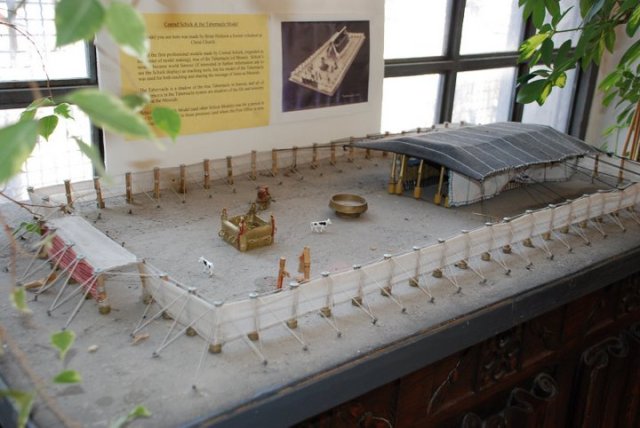
 

The Tabernacle Courtyard

The Tabernacle Courtyard

In our previous postings we have presented the Tabernacle Courtyard as prophetic of the Jesus in that it foretells the life of Christ. We will now continue with our larger objective of substantiating the Tabernacle and its contents as prophetic of Christ Jesus.
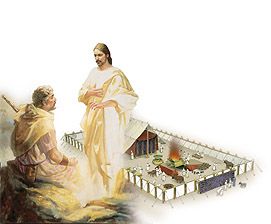
Jesus and Moses at the Transfiguration Discuss the Fulfillment of the Tabernacles Prophesy

Jesus and Moses at the Transfiguration Discuss the Fulfillment of the Tabernacles Prophesy

To initiate this quest we will start with a review of all of the material we have presented to date, which addresses the Tabernacle Courtyard and demonstrates that Jesus is the Way to a relationship of grace with God.


The foundation for all of the work we will present on this subject is based upon the, “I am the Way, the Truth and the Life,” statement made by Jesus. What we have revealed is that these names, (the way, the truth and the life), are also used to name the entrances into the Tabernacle chambers. “The Way,” for example is the name of the gate that leads into the Tabernacle Courtyard.

The Tabernacle Gate - The Way

The Tabernacle Gate - The Way

The Truth is the name of the door into the Holy Place,

The Brazen Laver In Front Of "The Way" To The Holy Place

and in like manner, “the Life,” is the passage into the Most Holy place of God. For a more detailed explanation of all of this please follow this link Jesus-is-the-Way-the-Truth-and-the-Life.
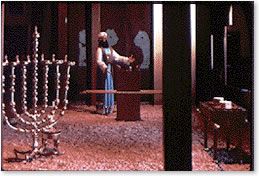
Priest in the Holy Place of the Tabernacle

Priest in the Holy Place of the Tabernacle

Another part of the work covered to date is that the Tabernacle is the place where God promised to dwell with His people in accordance with the covenant He made with them. Given that the chambers of the Tabernacle must be entered in sequence, what we have uncovered is that a progressively intimate relationship with God is achieved as each new chamber is entered. So for example, the Tabernacle Courtyard is the chamber where a relationship of grace (forgiveness of sin) is achieved. The Holy Place brings us to a relationship of enlightenment (purpose and path) and empowerment (spiritual warfare), while the Most Holy place offers a relationship of covenant (dwelling under the protection of God).

To date our investigation of the Tabernacle has been limited to looking at the Courtyard, the first of the three chambers of the Tabernacle. As a part of this investigation we have presented the objects found in the Courtyard, including their purpose and attributes and correlated them to the words and deeds of Jesus. So, for example, we found that grace is achieved in the Courtyard by way of blood sacrifice, in which a Lamb is slaughtered and then burned on the Brazen Alter (see details at Jesus-the-Brazen-Laver.) We then associated Jesus, the “Lamb of God,” to this object by correlating it to His sacrifice and death on the cross.
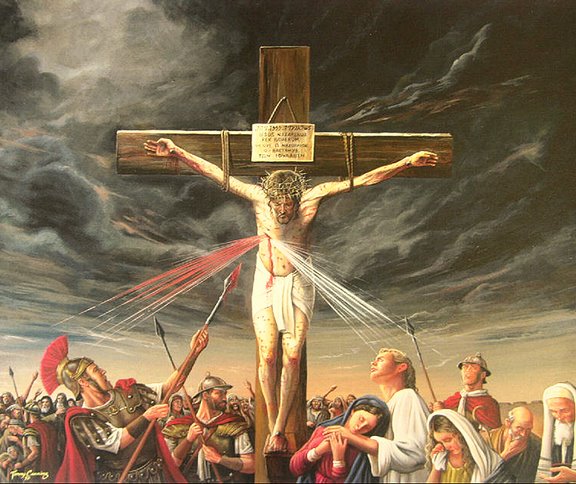
Jesus on the Cross Sheds His Blood

This sacrifice was required for the forgiveness of our sins. It also substantiates that Jesus as the fulfillment of the Brazen Altar and therefore the Courtyard of the Tabernacle. This correlation should also help us to better understand what Jesus meant when He said “I am The Way,” which means that He is the way of a relationship of grace. For more information about this please go to Jesus-is-the-Way and Becoming-like-Jesus-the-Way.

Our investigation of the Courtyard also presented an examination of the Brazen Laver, which is the other object found in the Tabernacle Courtyard (for more details go to Jesus-the-Brazen-Laver.) The Laver is a water basin used for purification prior to entering the next chamber (the Holy Place) and a closer relationship with God. The process of washing at the Laver required the priest to bend over it and as he did, he would see his reflection in its polished surface. The priests believed that when they looked into the Laver, that they saw themselves as God saw them. As a result their hidden faults were uncovered and they earnestly contemplated their worthiness to enter into a closer relationship with God in the Holy Place. This reflection resulted in a change in heart, which is necessary to enter into the Holy Place.

We then connected the function and attributes of the Laver with the life and words of Jesus. We used the baptism of Jesus in the Jordan as a fulfillment of prophesy of the Laver (for more information go to the-Laver-and-the-Holy-Spirit-of-Jesus.)
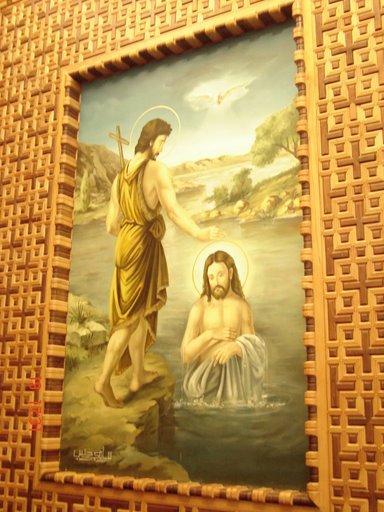
John Baptizes Jesus - Making Straight The Way Of The Lord

John Baptizes Jesus - Making Straight The Way Of The Lord

We also saw how the washing His disciple’s feet became a reflection of their readiness to enter into His ministry. In general we conclude that all of the words and deeds of Jesus are occasions for reflection and opportunities for change in preparation for ministry. Therefore our reading of scriptures that contain the words and deeds of Jesus are opportunities for reflection about our nature and how we stack up to in comparison to Jesus, our model of perfection. These occasions are opportunities to conform our heart and mind to Him as we pursue a more intimate relationship to our God. For additional information about this go to Applying-the-attributes-of-Jesus-our-Laver.

So, by passing through “the Way” and into the Tabernacle Courtyard we find that our sins are forgiven and that our nature is changed as we seek to move into a deeper relationship with the Lord in the Holy Place. In a like manner we find that by passing through Jesus that our sins are forgiven and our nature is changed as we read His word and seek to become like Him. When this metamorphosis is complete we become ready to move to the next level by entering the passageway called “The Truth.”


The Truth leads us into the Holy Place of God where our pathway is enlightened, our relationship with the Father is matured and we become empowered for spiritual warfare. Now we are ready to introduce you to, “Jesus the Truth” in our subsequent postings.  


The Morning Star Rising on the First Day

The Brazen Laver


The Brazen Laver is second of two objects located in the Tabernacle’s Courtyard.


Then you shall set the altar of the burnt offering before the door of the tabernacle of the tent of meeting. And you shall set the laver between the tabernacle of meeting and the altar, and put water in it. (Exodus 40:6-7)

tabernacle-courtyard

The Laver’s function was to provide a place for the priests to purify themselves prior to serving in ministry or entering the Tabernacle’s Holy Place. As the following passage suggests, purification is a required precursor to priestly ministry.


You shall also make a laver of bronze, with its base also of bronze, for washing. You shall put it between the tabernacle of meeting and the altar. And you shall put water in it, for Aaron and his sons shall wash their hands and their feet in water from it. When they go into the tabernacle of meeting, or when they come near the altar to minister, to burn an offering made by fire to the LORD, they shall wash with water, lest they die. (Exodus 30:18-20)


The Brazen Laver therefore is a wash basin made of polished bronze (which is derived from the word, brazen). The bronze surface is polished to such a highly reflective state that it obtains mirror like qualities. In fact, the Laver was made from the bronze mirrors of the serving women who assembled at the door of the tabernacle of meeting (Exodus 38:8). Because of this reflective characteristic, the priests were able to see their reflection in the Laver as they bent over it to wash.


Jesus is the Way

We now plan to present an investigation into the significance of Jesus’ statement; “I am the Way, the Truth and the Life,” with our primary focus for this post to be on what Jesus meant when He said “I am the Way.”

lamb


Our strategy is to draw parallels to the Tabernacle Courtyard as the passage way into this chamber of the Tabernacle is also called “the Way.” So the Tabernacle Courtyard will become a starting point of our investigation as we will present its artifacts, attributes and purpose.

the-full-tabernacle


Once we have achieved an understanding of the Courtyard we will turn our attention to the parallels in the life of Jesus. We will demonstrate that His life and words reveal Him to be the Courtyards’ prophetic promise for the forgiveness of sin through Gods’ relationship of grace with man. With that said, let us move on to looking at the Tabernacle Courtyard.

The Courtyard is enclosed by a linen fence and a gate (called the Way) that provides entry into the Tabernacle. Three objects can be found in the Courtyard. They are the Altar of Burnt Offerings, the Brazen Laver and the Sanctuary tent.

Upon the Altar of Burnt Offerings animal and blood sacrifices were made for the forgiveness of sins. The Brazen Laver was used for cleansing by the priest after performing their duties in the Tabernacle Courtyard and prior to entering into the Sanctuary tent.

To learn about the Tabernacle Fence and Gate follow the link below:

The-Tabernacle-Fence-And-Gate

tabernacle-gate

To learn about the Altar of Burnt Offerings follow the link below:

The-Altar-Of-Burnt-Offerings

To learn about the Activities at the Altar of Burnt Offerings follow the link below:

The-Activities-At-The-Altar-Of-Burnt-Offerings

Next our attention will turn to looking for parallels in the life of Jesus, starting with the Altar of Burnt offerings. First we will look at Jesus being the sacrifice for our sins because He is the Lamb of God. Next we will look at Jesus from the standpoint of being the good shepherd as He gave His life on the cross for us.

To learn about Jesus the Lamb of God follow the link below:

tabernacle-courtyard


Jesus-Is-The-Lamb-Of-God

To learn about Jesus the Altar of Burnt Offerings follow the link below:

Jesus-Is-The-Altar-Of-Burnt-Offerings

To learn about Jesus the Good Shepherd follow the link below:

Jesus-Is-The-Good-Shepherd

p1010227

The Good Shepherd gave up His life for His sheep.

The Brazen Laver is another object found inside the Tabernacle Courtyard. It’s main purpose is to allow for the cleansing of the priest prior to ministry. The following link will take you to the post that describes the Tabernacles’ Laver:

The-Brazen-Laver

One of the ways that can claim that Jesus is the fulfillment of Tabernacle prophesies is by looking at the baptism of Jesus in the Jordan River. The following link will take you to this discussion.

The-Baptism-Of-Jesus-And-The-Brazen-Laver

john-baptizes-jesus


Read my amazing true life story about how the forces of good and evil battle for my life and the vision that God has given me. My book, “Possess the Vision,” communicates my supernatural experiences and as a result, provides insight into the realm of the spiritual warfare that is raging for our souls and our purpose. This is a must read for all Christians. Learn more by following this link: Possess-the-Vision-at-Amazon

The Morning Star Rising on the First Day

The Activities at the Altar of Burnt Offerings

The activities performed at the Altar give valuable insight into what was actually being accomplished there.

tabernacle-courtyard

The following passage taken from the Book of Leviticus describes one of the many processes that God gave Moses to perform at the Altar of Burnt Offerings:

It came to pass on the eighth day that Moses called Aaron and his sons and the elders of Israel. And he said to Aaron, “Take for yourself a young bull as a sin offering and a ram as a burnt offering, without blemish, and offer them before the LORD. And to the children of Israel you shall speak, saying, Take a kid of the goats as a sin offering, and a calf and a lamb, both of the first year, without blemish, as a burnt offering, also a bull and a ram as peace offerings, to sacrifice before the LORD, and a grain offering mixed with oil; for today the LORD will appear to you.” So they brought what Moses commanded before the tabernacle of meeting. And all the congregation drew near and stood before the LORD. Then Moses said, “This is the thing which the LORD commanded you to do, and the glory of the LORD will appear to you.” And Moses said to Aaron, “Go to the altar, offer your sin offering and your burnt offering, and make atonement for yourself and for the people. Offer the offering of the people, and make atonement for them, as the LORD commanded.” Aaron therefore went to the altar and killed the calf of the sin offering, which was for himself. Then the sons of Aaron brought the blood to him. And he dipped his finger in the blood, put it on the horns of the altar, and poured the blood at the base of the altar. But the fat, the kidneys, and the fatty lobe from the liver of the sin offering he burned on the altar, as the LORD had commanded Moses. The flesh and the hide he burned with fire outside the camp. And he killed the burnt offering; and Aaron’s sons presented to him the blood, which he sprinkled all around on the altar. Then they presented the burnt offering to him, with its pieces and head, and he burned them on the altar. And he washed the entrails and the legs, and burned them with the burnt offering on the altar. Then he brought the people’s offering, and took the goat, which was the sin offering for the people, and killed it and offered it for sin, like the first one. And he brought the burnt offering and offered it according to the prescribed manner. Then he brought the grain offering, took a handful of it, and burned it on the altar, besides the burnt sacrifice of the morning. He also killed the bull and the ram as sacrifices of peace offerings, which were for the people. And Aaron’s sons presented to him the blood, which he sprinkled all around on the altar, and the fat from the bull and the ram; the fatty tail, what covers the entrails and the kidneys, and the fatty lobe attached to the liver; and they put the fat on the breasts. Then he burned the fat on the altar; but the breasts and the right thigh Aaron waved as a wave offering before the LORD, as Moses had commanded. Then Aaron lifted his hand toward the people, blessed them, and came down from offering the sin offering, the burnt offering, and peace offerings. And Moses and Aaron went into the tabernacle of meeting, and came out and blessed the people. Then the glory of the LORD appeared to all the people, and fire came out from before the LORD and consumed the burnt offering and the fat on the altar. When all the people saw it, they shouted and fell on their faces. (Leviticus 9:1-24)

The Tabernacle Courtyard

The Tabernacle Courtyard

The Altar therefore, was the place that the priesthood offered blood and animal sacrifices on behalf of the people. These sacrifices included covering the priest, the Altar, the people and the objects inside the Tabernacle in the blood of the sacrifice, for the covering of sin[i]. Tradition has it that the process often involved the head of the family (who represented the entire family), to bring a perfect sacrifice (a lamb without spot, stain or blemish) to the Tabernacle court. The family head would hold the animal down with his hands, therein transferred the sins of the family to the animal. The priest would then cut the animals throat so that the sins of the family flowed out with its blood.

If he brings a lamb as his sin offering, he shall bring a female without blemish. Then he shall lay his hand on the head of the sin offering, and kill it as a sin offering at the place where they kill the burnt offering. The priest shall take some of the blood of the sin offering with his finger, put it on the horns of the altar of burnt offering, and pour all the remaining blood at the base of the altar. He shall remove all its fat, as the fat of the lamb is removed from the sacrifice of the peace offering. Then the priest shall burn it on the altar, according to the offerings made by fire to the LORD. So the priest shall make atonement for his sin that he has committed, and it shall be forgiven him. (Leviticus 4:32-35)

We will present how Jesus fulfills the prophesy of the Altar of Burnt Offerings and all of the activities performed around it in our next posting.


The Altar of Burnt Offerings

The Altar of Burnt Offerings can clearly be seen in the following picture. It is the object producing the flames in the center of the Tabernacle Courtyard.

the-full-tabernacle6

At the time of the Levitical Priesthood, God required blood sacrifices at the Alter of Burnt Offerings for the forgiveness of sins. These sacrifices required the priest to slaughter a goat, sheep or cow and have the choice body parts burned on the Altar. Then the priest would sprinkle the blood of the animal on the Altar, the people and himself.

Like all of the objects in the Tabernacle, God provided the specifications for building the Altar of Burnt Offerings. This is evidenced by the following scripture:

You shall make an altar of acacia wood, five cubits long and five cubits wide; the altar shall be square; and its height shall be three cubits. You shall make its horns on its four corners; its horns shall be of one piece with it. And you shall overlay it with bronze. Also you shall make its pans to receive its ashes, and its shovels and its basins and its forks and its firepans; you shall make all its utensils of bronze. You shall make a grate for it, a network of bronze; and on the network you shall make four bronze rings at its four corners. You shall put it under the rim of the altar beneath, that the network may be midway up the altar. And you shall make poles for the altar, poles of acacia wood, and overlay them with bronze. The poles shall be put in the rings, and the poles shall be on the two sides of the altar to bear it. You shall make it hollow with boards; as it was shown you on the mountain, so shall they make it. (Exodus 27:1-8)

The Brazen Altar (or Alter of Burnt Offerings) is made of acacia wood and is covered with bronze. It is about ten and one half feet long, ten and one half feet deep and six feet three inches tall. There are horns of equal size placed on each of the corners of the Altar. It should be noted that there are a number of tools available to assist the priest in his work.


The Morning Star Rising on the First Day

Read my story by ordering my book, “Possess the Vision”

The Tabernacle Fence and Gate


The Tabernacle fence and gate can be seen in the following pictures:


the-full-tabernacle5


tabernacle-gate

The following passage from the book of Exodus defines the fence that encircles the Courtyard:


You shall also make the court of the tabernacle. For the south side there shall be hangings for the court made of fine woven linen, one hundred cubits long for one side. And its twenty pillars and their twenty sockets shall be bronze. The hooks of the pillars and their bands shall be silver. Likewise along the length of the north side there shall be hangings one hundred cubits long, with its twenty pillars and their twenty sockets of bronze, and the hooks of the pillars and their bands of silver. And along the width of the court on the west side shall be hangings of fifty cubits, with their ten pillars and their ten sockets. The width of the court on the east side shall be fifty cubits. The hangings on one side of the gate shall be fifteen cubits, with their three pillars and their three sockets. And on the other side shall be hangings of fifteen cubits, with their three pillars and their three sockets. For the gate of the court there shall be a screen twenty cubits long, woven of blue, purple, and scarlet thread, and fine woven linen, made by a weaver. It shall have four pillars and four sockets. All the pillars around the court shall have bands of silver; their hooks shall be of silver and their sockets of bronze. The length of the court shall be one hundred cubits, the width fifty throughout, and the height five cubits, made of fine woven linen, and its sockets of bronze. All the utensils of the tabernacle for all its service, all its pegs, and all the pegs of the court, shall be of bronze. (Exodus 27:9-19)


More information Can be found about the Tabernacle Gate by clicking on the following link: The-Tabernacle-Gate


Read my amazing true life story about how the forces of good and evil battle for my life and the vision that God has given me. My book, “Possess the Vision,” communicates my supernatural experiences and as a result, provides insight into the realm of the spiritual warfare that is raging for our souls and our purpose. This is a must read for all Christians. Learn more by following this link: Possess-the-Vision-at-Amazon


The Morning Star Rising on the First Day

Read my story by ordering my book, “Possess the Vision”

The Tabernacle and Jesus


The Tabernacle was built to be the earthly abode of God and the place where God would dwell among His people.

The following picture depicts what the Tabernacle of Moses may have looked like:

the-tabernacle

Moses built the Tabernacle in conformance to the exact specifications provided by God. For example, God gives Moses a detailed list of items required to build the Tabernacle in the following scripture:


Then the LORD spoke to Moses, saying: “Speak to the children of Israel, that they bring Me an offering. From everyone who gives it willingly with his heart you shall take My offering. And this is the offering which you shall take from them: gold, silver, and bronze; blue, purple, and scarlet thread, fine linen, and goats’ hair; ram skins dyed red, badger skins, and acacia wood; oil for the light, and spices for the anointing oil and for the sweet incense; onyx stones, and stones to be set in the ephod and in the breastplate. And let them make Me a sanctuary, that I may dwell among them. According to all that I show you, that is, the pattern of the tabernacle and the pattern of all its furnishings, just so you shall make it.” (Exodus 25:1-9)


This passage also emphasizes the building of God’s Tabernacle precisely to His instructions. This is just one of several statements found in scripture regarding God’s desire to have the Tabernacle built precisely to His instruction. This fact suggests that the Tabernacle’s form and content are extremely important; that it is built on a heavenly model designed to enable God to dwell among His people. This is because He seeks to restore the relationship with man that was lost in the garden.

We must now consider that if all of this is true then should not the Son of God also possess all of the attributes and functionality of the Tabernacle? What we will demonstrate is that the Tabernacle is prophetic of Christ. Would the purpose of God have changed from the time of Moses until the time of Christ? I think not. God continues to strive to restore the relationship lost with man at the fall. Therefore, we believe that the Tabernacle is prophetic of Christ. We believe that when we look at the functions and purpose of the Tabernacle and each of its components, that we will find them predictive of the function and purpose in the life of Christ Jesus. It is for this reason that we will use the Tabernacle and it components to demonstrate that Jesus is the Christ.

For example, we believe that the Tabernacle should give us some insight into the types of relationships that man can have with God. We further believe that if the pattern of the Tabernacle provides this insight then we should expect to see these types of relationships manifest through Christ as well.

What we are about to find out is that the Tabernacle not only helps us understand the types of relationships possible with God but that these relationships were manifest through the life of Jesus.

When we look into the physical structure of the Tabernacle we will find that it is composed of three major sections. The sections can only be entered in an order that represents a deeper or closer relationship with God.

The first section is the Tabernacle Court and it presents man with a relationship of God’s grace. When Jesus claims to be the Way, He is claiming to be the passageway to the Tabernacle Court.


tabernacle-courtyard


The second section of the Tabernacle is called the Holy Place and it is presents man with a relationship of God’s empowerment. When Jesus claims to be the Truth, He is claiming to be the passageway to the Holy Place of the Tabernacle.


holy-place


The third section of the Tabernacle is called the Most Holy place and it presents man with a relationship of covenant. When Jesus claims to be the Life He is claiming to be the passageway to the Most Holy Place.


priest-and-holy-of-holies


Read my story by ordering my book, “Possess the Vision”


Jesus is the Way, the Truth, and the Life

Jesus made a number of statements about His identity in scripture. However, the following statement is the foundation of our analysis as in Jesus correlates Himself to the Tabernacle. The statement is presented here:

Thomas said to Him, “Lord, we do not know where You are going, and how can we know the way?” Jesus said to him, “I am the way, the truth, and the life. No one comes to the Father except through Me.” (John 14:5-6)

This statement is compelling on its face value alone as we know that Jesus is talking about being the passageway to the Father. However, the terms, “The Way, The Truth and The Life” are symbolic of the passageways (or veils) into each compartment of the Tabernacle. In turn each passageway leads to a progressively deeper relationship with the Father. We will learn a great deal more about these passageways in subsequent postings.

Let us first start by presenting a scripture that confirms that Jesus viewed His body as a temple (which the Tabernacle is)[i]:

So the Jews answered and said to Him, “What sign do You show to us, since You do these things?” Jesus answered and said to them, “Destroy this temple, and in three days I will raise it up.” Then the Jews said, “It has taken forty-six years to build this temple, and will You raise it up in three days?” But He was speaking of the temple of His body. (John 2:18-21)

In speaking these words, Jesus is claiming to be the living Tabernacle and the divine fulfillment of all prophesies regarding it. To validate this assumption, we will now embark on a detailed investigation of the Tabernacle in the anticipation that it will guide us to Christ. We will examine the function and purpose of each Tabernacle object and will look at many of the process performed by the priests there as well.


[i] Revelation 15:5 After these things I looked, and behold, the temple of the tabernacle of the testimony in heaven was opened.


Jesus The Brazen Laver

The Brazen Laver is second of two objects located in the Tabernacle’s Outer Court.

Then you shall set the altar of the burnt offering before the door of the tabernacle of the tent of meeting. And you shall set the laver between the tabernacle of meeting and the altar, and put water in it. (Exodus 40:6-7)

The Laver’s function was to provide a place for the priests to purify themselves prior to serving in ministry or entering the Tabernacle’s Holy Place. As the following passage suggests, purification is a required precursor to priestly ministry.

You shall also make a laver of bronze, with its base also of bronze, for washing. You shall put it between the tabernacle of meeting and the altar. And you shall put water in it, for Aaron and his sons shall wash their hands and their feet in water from it. When they go into the tabernacle of meeting, or when they come near the altar to minister, to burn an offering made by fire to the LORD, they shall wash with water, lest they die. (Exodus 30:18-20)

The Brazen Laver therefore is a wash basin made of polished bronze (which is derived from the word, brazen). The bronze surface is polished to such a highly reflective state that it obtains mirror like qualities. In fact, the Laver was made from the bronze mirrors of the serving women who assembled at the door of the tabernacle of meeting (Exodus 38:8). Because of this reflective characteristic, the priests were able to see their reflection in the Laver as they bent over it to wash.

So, with these facts in mind, let’s look deeper into the scriptures relating to the Brazen Laver. As we progress from this point, we will attempt to correlate what the scriptures have to say in support of the proposition that Jesus is our Brazen Laver and therefore the Christ. In this regard we will be looking to answer four basic questions; first, what did Jesus (and others) claim in this regard? Second, what were the actions of Jesus that support these claims? Third, what did the Father do in support of the words and actions of Jesus? Finally, what are the common attributes shared by our Lord Jesus and the Brazen Laver, and how can we integrate them into our lives?

We will now proceed to looking at Jesus as the Brazen Laver from these perspectives.

The Baptism of Jesus

The ministry of John the Baptist was to make straight the path of the Lord[i] who was to come. He preached repentance of sin and baptism in water for the remission of sin. John’s ministry led the people toward purity in preparation for their entering into a closer, more spiritual relationship with God.

Baptism was soon to take an entirely new form when Jesus came to John to be baptized. Although He was without sin[ii], Jesus was baptized by John in water to fulfill the model of the Brazen Laver that required purity through washing prior to entering ministry. The new form of baptism was introduced as Jesus came up from the water and the Holy Spirit descended upon Him in the form of a dove, thus signifying the ultimate form of purity. From that point forward Jesus was empowered by the Holy Spirit and therefore ready for ministry.

In addition, He was then able to baptize others with the Holy Spirit, therein empowering them from on high. This enabled His disciples to minister with power and to have a deeper spiritual relationship with God. Let’s look at the scriptures that support these statements:

The beginning of the gospel of Jesus Christ, the Son of God. As it is written in the Prophets: “Behold, I send My messenger before Your face, Who will prepare Your way before You. The voice of one crying in the wilderness: ‘Prepare the way of the LORD; Make His paths straight.’“ John came baptizing in the wilderness and preaching a baptism of repentance for the remission of sins. Then all the land of Judea, and those from Jerusalem, went out to him and were all baptized by him in the Jordan River, confessing their sins. (Mark 1:1-5)

Like the priest washing at the Brazen Laver, John was preparing the people for entering into a closer relationship with God. The Father had sent His son, the living Tabernacle, to earth and now the Father was empowering Jesus to accomplish His mission on earth:

And he preached, saying, “There comes One after me who is mightier than I, whose sandal strap I am not worthy to stoop down and loose. I indeed baptized you with water, but He will baptize you with the Holy Spirit.” It came to pass in those days that Jesus came from Nazareth of Galilee, and was baptized by John in the Jordan. And immediately, coming up from the water, He saw the heavens parting and the Spirit descending upon Him like a dove. Then a voice came from heaven, “You are My beloved Son, in whom I am well pleased.” Immediately the Spirit drove Him into the wilderness. And He was there in the wilderness forty days, tempted by Satan, and was with the wild beasts; and the angels ministered to Him. (Mark 1:7-13)

So, the purification of the priests in water of the Laver is prophetic of the baptism of Christ Jesus, our high priest, in the Holy Spirit. We can conclude from this that repentance and baptism are very important components prior to ministry. Water baptism is so important that our Lord Jesus came to be baptized by John. In doing so He gave us a model that to emulate. A model that when emulated by those who truly repent and seek to do God’s will, results in the baptism in the Holy Sprit. The point in all of this is that the baptism of the Holy Spirit brings us to a closer relationship with God. It brings fellowship with the Father, enlightenment to God’s truth, and empowerment for the battle of ministry. All three of these blessings of relationship are also prophesied by the objects found in the Holy Place of the Tabernacle, which can only be entered by a purified priest. We cover all of this in our next major section, but we introduce it here to draw the connection between the baptism of Jesus and the purification of the priest at the Laver. Both were done prior to ministry. Both were prerequisites to a closer relationship with the Father and His blessings necessary for ministry. But we are getting ahead of ourselves a bit here, so let’s once again focus on the correlation between the Laver and Christ Jesus. This is where we will begin in our next posting.

May God bless all of you. I look forward to hearing any comments that you may have.


[i] John 1:22 – 23 Then they said to him, “Who are you, that we may give an answer to those who sent us? What do you say about yourself?” He said: “I am ‘The voice of one crying in the wilderness: “Make straight the way of the LORD,” ‘ as the prophet Isaiah said.

[ii] Hebrews 4:15 For we do not have a High Priest who cannot sympathize with our weaknesses, but was in all points tempted as we are, yet without sin.


The Tabernacle Most Holy Place Is Prophetic of Jesus

In this post we continue to present our case that the Tabernacle of Moses is Prophetic of Jesus. To get a good foundational understanding of the Tabernacle go to the following posting: The-Tabernacle-Is-Prophetic-Of-Jesus. Reading this post will help us to better understand the material presented here.

We have also presented a post on the Tabernacle Courtyard and suggest that reading it may be helpful in improving our comprehension of the Most Holy Place and how it is prophetic of Jesus. This post can be found by following the following link: The-Tabernacle-Courtyard-And-Jesus.

We have also offered a post on the Tabernacle Holy Place and in like manner, we suggest that a review of it will help in the understanding of the following material. The post on the Holy Place can be viewed by following this link: The-Tabernacle-Holy-Place-Is-Prophetic-Of-Jesus

So, with that said, lets present the Most Holy Place of the Tabernacle.

As we pass through the Tabernacle entrance called “the Life,” we enter into God’s Most Holy Place. It is in the Most Holly Place where we enter into God’s gift of covenant. It is here that we can talk to God directly in the presence of His holy angels. It is here where our every need is cared for. In the Most Holy place we enter into a sacred and Royal Priesthood that both understand and lives God’s commandments.

When correlating the objects found in the Most Holy Place to the actions and words of Jesus, we again find the Jesus is a far superior replacement for the old covenants’ Most Holy Place. It is Jesus who has become the ark of the New Covenant that is based on love. It is Jesus who is our high priest who enables us to enter into His Royal Priesthood. It is through Jesus that our every need is cared for. It is through Jesus that our relationship with the Father is restored, enabling things to become as they were in the beginning in the Garden of Eden.

So we have much to discover about Jesus as we initiate our investigation into His words that lead us to the Tabernacle where we will find a deeper relationship with Him. We will drill down into all of this by starting with “Jesus the Way”, in our next posting. I look forward to your comments and discussion.

For additional details on the Most Holy Place of the Tabernacle please follow the following links:

Jesus-is-the-Life

Jesus-the-Most-Holy-Place

Finding-Jesus-in-the-Holy-of-Holies

Inside-the-Most-Holy-Place

Going-into-the-Ark-of-the-Covenant

Jesus-is-the-Fulfillment-of-the-Law

The-Cross-of-Jesus-is-the-Rod-of-Aaron

Jesus-is-our-Priest-Forever

Jesus-is-our-Covenant-Provision

Jesus-and-the-Covenant

Jesus-is-the-Way-to-the-Promised-Land

Jesus-is-the-Spirtual-Foundation-of-the-New-Covenant

Jesus-Prepares-us-to-Enter-into-His-Spirit

The-Spiritual-Duty-of-the-Warrior-Nation

Jesus-is-the-Reward-of-the-Spirit-Filled-Warrior-Nation

Jesus-and-the-Bride-of-Christ

Jesus-and-the-Cherubim

Jesus-is-the-Mercy-Seat-where-God-Dwells