
Read my amazing true life story about how the forces of good and evil battle for my life and the vision that God has given me. My book, “Possess the Vision,” communicates my supernatural experiences and as a result, provides insight into the realm of the spiritual warfare that is raging for our souls and our purpose. This is a must read for all Christians. Learn more by following this link: Possess-the-Vision-at-Amazon
Entering The Truth Of The Tabernacle

The Tabernacle Courtyard
In our previous postings we have communicated how the Tabernacle Courtyard is prophetic of Jesus Christ. The Courtyard foretells the blood sacrifice required of Jesus as payment for our sins on the cross. It also communicates that we must look at ourselves in light of the prefect model of Jesus. We must compare our actions and words to His since He is the Son of God and led a perfect life. In doing these things we enter into a relationship of grace with God. This fundamental relationship with God prepares us for a closer and more intimate relationship with Him. It prepares us for a relationship of empowerment, which is presented below in the section entitled “Jesus is the Truth.”

The Tabernacle Courtyard
Our immediate objective is to present a review of the material that covers the Tabernacle as it pertains to the prophesy of Jesus Christ. We start with one of the most famous statements of Jesus, “I am the Way, the Truth and the Life.”
The Way the Truth and the Life
The foundation for all of the work we will present on this subject is based upon the, “I am the Way, the Truth and the Life,” statement made by Jesus. What we have discovered is that these names, (the way, the truth and the life), are the names used to identify the entry ways into the Tabernacle chambers. “The Way,” for example is the name of the gate that leads into the Tabernacle Courtyard. “The Truth” is the name of the door into the Holy Place, and in like manner, “the Life,” is the passage into the Most Holy place of God. For a more detailed explanation of all of this please follow this link Jesus-is-the-Way-the-Truth-and-the-Life.

The Tabernacle Gate
Another part of the work covered to date is that the Tabernacle is the place where God promised to dwell with His people in accordance with the covenant He made with them. Given that the chambers of the Tabernacle must be entered in sequence, what we have uncovered is that a progressively closer relationship with God is achieved as each new chamber is entered. So for example, the Tabernacle Courtyard is the chamber where a relationship of grace (forgiveness of sin) is achieved. The Holy Place brings us to a relationship of enlightenment (purpose and path) and empowerment (spiritual warfare), while the Most Holy place offers a relationship of covenant (dwelling under the protection of God).
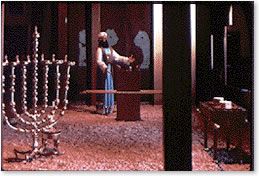
Priest in the Holy Place of the Tabernacle
To date our investigation of the Tabernacle has been limited to looking at the Courtyard, the first of the three chambers of the Tabernacle. As a part of this investigation we have presented the objects found in the Courtyard, identified their purpose and attributes and then correlated them to the words and deeds of Jesus. So, for example, we found that grace is achieved in the Courtyard by way of blood sacrifice, in which a Lamb is slaughtered and then burned on the Brazen Alter (see details at Jesus-the-Brazen-Laver.) We can then associate Jesus, the “Lamb of God,” to this object by correlating it to the sacrifice and death of Jesus on the cross. This sacrifice of Jesus was required for the forgiveness of our sins. We conclude form all of this that Jesus is the fulfillment of the Brazen Altars prophesy and the entire Courtyard of the Tabernacle for that matter. This association between Jesus and the Tabernacle Courtyard should also help us to better understand what Jesus meant when He said “I am The Way.” Jesus meant that He is the way toward a relationship of grace. For more information about this please click on the following links to Jesus-is-the-Way and Becoming-like-Jesus-the-Way.

Jesus on the Cross
Our investigation of the Courtyard is also presented an examination of the Brazen Laver, which is the other object found in the Tabernacle Courtyard (for more details go to Jesus-the-Brazen-Laver.) The Laver is a water basin used for purification prior to entering the next chamber (the Holy Place), which represented a much closer relationship with God. The process of washing at the Laver required the priest to bend over it and as he did, he would be able to see his own reflection in its polished surface. The priests believed that when they looked into the Laver, that they saw themselves as God saw them. As a result their hidden faults were uncovered and they earnestly contemplated their worthiness to enter into a closer relationship with God in the Holy Place. This reflection resulted in a change in heart, which is necessary to enter into the Holy Place.

We then connected the function and attributes of the Laver with the life and words of Jesus. We used the baptism of Jesus in the Jordan as a fulfillment of prophesy of the Laver (for more information go to the-Laver-and-the-Holy-Spirit-of-Jesus.) We also saw how the washing of His disciple’s feet became a reflection of their readiness to enter into His ministry. In general we conclude that all of the words and deeds of Jesus are occasions for reflection and opportunities for change in preparation for ministry. Therefore our reading of scriptures that contain the words and deeds of Jesus are opportunities for reflection about our nature and how we stack up to in comparison to Jesus, our model of perfection. These occasions are opportunities to conform our heart and mind to Him as we pursue a more intimate relationship with God. For more detailed information about this click on the following link Applying-the-attributes-of-Jesus-our-Laver.
So, by passing through “the Way” and into the Tabernacle Courtyard we find that our sins are forgiven and that our nature is changed as we seek to move into a deeper relationship with the Lord in the Holy Place. In a like manner we find that by passing through Jesus that our sins are forgiven and our nature is changed as we read His word and seek to become like Him. When this metamorphosis is complete we become ready to move to the next level by entering the passageway called “The Truth.”
The Truth leads us into the Holy Place of God where our pathway with the Lord is enlightened, our relationship with the Father is established and we become empowered for spiritual warfare. We are ready to provide a deeper assessment of, “Jesus the Truth.”
Jesus is “The Truth”
We are now about to pass through the second door of the Tabernacle, the one called “the Truth”, that leads us into the Holy Place of God. To see a diagram of the Tabernacle chambers we encourage you to go to the following web page now and then return once you have viewed it (or open it in a separate browser so that you can read along while also looking at the picture):
Diagram of the Tabernacle, Basic Layout of the Moses tabernacle
In order to get a big picture view of where we are headed in the over all scheme of things we start with a review:
When we look into the structure of the Tabernacle (like in the diagram above) we find that it has three major chambers. As we pass through the door of each successive chamber we find that God is presenting us with an expanded, more intimate relationship with Him.
We have already discussed the Way and the Courtyard above. We have identified that it presents us with a relationship of grace and is a place of reflection and change. When Jesus claimed to be the Way, He is claiming to be the door that we must pass through to achieve to a relationship of grace.
Our presentation of, “Jesus the Truth,” address the Holy Place of the Tabernacle and we plan to demonstrate that it is a place to achieve a relationship of empowerment. The passageway to the Holy Place is called “the Truth,” and so when Jesus claims to be “the Truth,” He is claiming to be the passageway to a relationship of empowerment.
In subsequent postings we will plan to present the Most Holy place and in doing so, we plan to present a case that proves that a relationship of covenant is possible for us there. The veil to the Most Holy place is called “the Life”, so when Jesus claims to be the Life, He is claiming to be the veil to the Most Holy Place and a relationship of covenant with God.

The Priest in the Most Holy Place of the Tabernacle
The relationship between the Tabernacle and Jesus is that Jesus claimed to be “the Way, the Truth and the Life” and the doors of the Tabernacle chambers are called, “the way, the truth and the life.” Therefore, if Jesus is the Christ, we will find the same attributes and functions in the life of Jesus as we do in the Tabernacle. We will find that understanding the Tabernacle will also help us to better understand the nature of Jesus such that we can better emulate His life. All of this will help us to move into a closer relationship with God and do the work that He gave us to do on this earth. So, with this brief review in place let up proceed by looking at the physical properties of the Holy Place of the Tabernacle.
Describing the Holy Place
The Holy Place is found inside the sanctuary tent that is found in the center of the Courtyard. The door to the tent is a curtain that is called, “The Truth.” By passing through the Truth one enters a room called, “The Holy Place.”
Prior to entering into the Holy Place it is necessary to first pass through the Courtyard and the Way (reference the diagram). The reason for this is that purity must be achieved prior to entering into ministry in God’s Holy place. Entry into the Holy Place is the exclusive privilege of the priest, as no others are allowed inside. Therefore, God expects our purity to be achieved in the Courtyard. Our sins must be forgiven and our sinful nature addressed.
Like the other compartments of the Tabernacle, the sanctuary was designed by God who passed the specifications directly to His servant Moses:
And let them make Me a sanctuary, that I may dwell among them. According to all that I show you, that is, the pattern of the tabernacle and the pattern of all its furnishings, just so you shall make it. (Exodus 25:8-9)
As a result the sanctuary is both very practical and at the same time, very prophetic of the coming Christ.
The Holy Place uses the east 30 feet of the sanctuary tent and contains three significant objects. It contains the Table of Showbread on the north side;

The Table of Showbread
the Golden Lampstand on the south side;
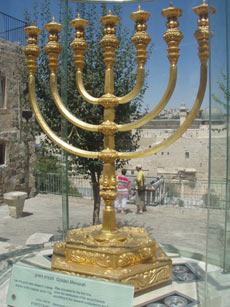
The Golden Lampstand which was present in old temple but damaged, was restored to its original form, kept outside the temple area.
and the Altar of Incense on the west side.
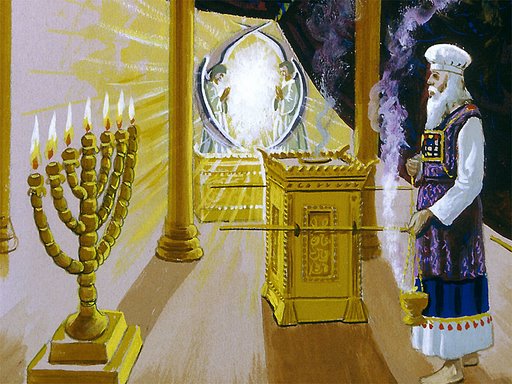
The Golden Altar is directly in front of the Most Holy Place
It should also be noted that the Golden Altar of Incense is placed directly in front of the vale (entrance) to the Most Holy Place. From this location a priest ministering at the Golden Altar can view the Ark of the Covenant and the Mercy Seat by simply looking through the semi-transparent vale. We will cover all of this later when we present the section called The Life. For now we will proceed to address the objects found in the Holy Place.
One major difference between the objects found in the Holy Place and Courtyard is that all the objects in the Holy place are made of gold, while all the objects in the Courtyard are made of brass. This is significant because one who stands in the Holy Place is in a more favored relationship with God than one who is in the Courtyard. The gold used in the Holy Place signifies the special presence of God. When we look at the uses of the word “gold” in the bible we find that gold was used to symbolize God’s Word, the wisdom of God, the knowledge that emanates from God, the living favor of God, and truth. All of these attributes are to be associated with the Holy Place and with Christ Jesus as well.
Our next posting will address the details of the Table of Showbread, the Golden Lampstand and the Alter of Burnt Offerings.
Read my amazing true life story about how the forces of good and evil battle for my life and the vision that God has given me. My book, “Possess the Vision,” communicates my supernatural experiences and as a result, provides insight into the realm of the spiritual warfare that is raging for our souls and our purpose. This is a must read for all Christians. Learn more by following this link: Possess-the-Vision-at-Amazon

 SEEKING JESUS